
AI-Driven Banking: From Prediction to Autonomous Lending
AI-Driven Banking is rapidly becoming the foundation of modern financial operations. What began as the use of predictive analytics for fraud detection and credit scoring has evolved into something far more transformative: intelligent systems capable of automating and optimizing entire lending lifecycles.
For banks and credit unions navigating margin pressure, rising compliance demands, and increasing borrower expectations, AI is no longer a peripheral innovation—it is a strategic operating advantage.
The next frontier is autonomous lending: a model in which AI not only predicts outcomes but actively powers underwriting, workflow orchestration, risk monitoring, and operational execution across the lending lifecycle.
What AI-Driven Banking Means for Modern Financial Institutions
AI-Driven Banking refers to the application of artificial intelligence, machine learning, and intelligent workflow automation across banking operations to improve efficiency, decision-making, and scalability.
In the lending environment, this means moving beyond siloed analytics tools toward integrated systems that can:
- Continuously assess borrower and portfolio risk
- Automate repetitive underwriting and servicing tasks
- Surface actionable insights in real time
- Trigger workflow actions based on business logic and risk thresholds
- Improve decision consistency across teams and geographies
Rather than augmenting operations at the margins, AI-driven banking is reshaping the operational core of financial institutions.
The Shift from Predictive Models to Autonomous Lending
Historically, banking AI has focused on prediction.
Financial institutions adopted machine learning models to:
- Forecast borrower default probability
- Detect anomalous transactions and fraud
- Assess portfolio concentration risks
- Identify cross-sell and upsell opportunities
While these capabilities improved insight generation, they still relied heavily on manual interpretation and human-led action.
Autonomous lending represents the next stage of maturity.
Autonomous Lending Defined
Autonomous lending extends AI beyond analytics by embedding intelligence directly into operational workflows. Instead of merely flagging risks or generating recommendations, autonomous systems help execute the lending process itself.
Capabilities include:
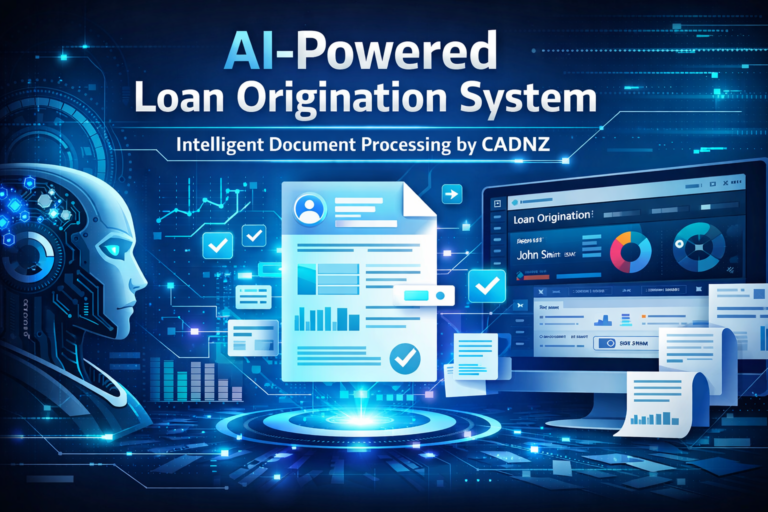
- Automated document ingestion and data extraction
- Dynamic financial spreading and ratio calculations
- Intelligent credit memo generation
- Rule-based exception handling
- Automated workflow routing and approvals
- Continuous post-close portfolio monitoring
This evolution shifts lending operations from reactive and labor-intensive to proactive, scalable, and system-driven.
Why Financial Institutions Are Prioritizing AI-Driven Banking
Banks and credit unions continue to face structural operational challenges that legacy technology stacks cannot adequately solve.
These include:
- Fragmented origination and servicing systems
- Manual underwriting bottlenecks
- Rising compliance complexity
- Limited portfolio risk visibility
- High operational cost per loan
- Borrower demand for faster decisions
AI-Driven Banking addresses these challenges by enabling institutions to modernize lending operations without sacrificing governance or risk discipline.
Strategic Benefits of Autonomous Lending
Increased Underwriting Throughput
By automating document collection, spreading, and analysis, institutions can process significantly more loans without proportionally increasing headcount.
Improved Risk Consistency
AI-driven models and rules engines ensure standardized credit analysis and reduce variability across underwriting teams.
Enhanced Portfolio Visibility
Real-time monitoring allows lenders to proactively identify emerging concentrations, covenant breaches, and deteriorating borrower conditions.
Lower Cost-to-Originate
Reducing manual touchpoints lowers operational expense and improves profitability across the lending function.
Faster Borrower Experience
Accelerated approval and onboarding processes improve client satisfaction and competitive positioning.
Core Technologies Enabling AI-Driven Banking
The transition to autonomous lending is powered by the convergence of several technologies:
Intelligent Document Processing
AI-powered extraction tools ingest and structure data from:
- Financial statements
- Tax returns
- Credit reports
- Bank statements
- Identification documents
This dramatically reduces manual review effort while improving data accuracy.
Machine Learning Risk Models
Advanced models evaluate:
- Borrower creditworthiness
- Cash flow strength
- Portfolio concentrations
- Collateral performance
- Probability of default
Workflow Automation Engines
Automation frameworks orchestrate:
- Approval routing
- SLA management
- Exception escalation
- Compliance checkpoints
- Post-close servicing tasks
Unified Operational Data Layers
AI effectiveness depends on integrated infrastructure.
Disconnected LOS, CRM, servicing, and risk systems limit automation potential and undermine data integrity.
A centralized operational platform is essential to unlock enterprise-scale AI-driven banking.
Why Platform Consolidation Is Critical for AI-Driven Banking
Many institutions attempt to deploy AI on top of fragmented legacy systems.
This creates significant limitations:
- Incomplete or inconsistent data inputs
- Broken automation workflows
- Duplicate operational processes
- Reduced model accuracy
- Inability to scale enterprise-wide
Successful AI-Driven Banking requires unified infrastructure where data, workflows, and operational teams are connected in one ecosystem.
How Cadnz Enables AI-Driven Banking
Cadnz provides financial institutions with a unified lending automation platform designed to operationalize AI-Driven Banking across the full lending lifecycle.
With Cadnz, banks and credit unions can:
Automate Underwriting Workflows
Accelerate financial spreading, credit memo generation, and approval routing.
Centralize Risk Management
Monitor portfolio exposure and borrower risk in real time through unified dashboards.
Streamline Compliance Operations
Automate audit trails, document filing, and regulatory workflows.
Unify Customer and Loan Data
Create a 360-degree borrower view across origination, servicing, and portfolio management.
By consolidating critical workflows into a single platform, Cadnz enables institutions to move from fragmented operations to intelligent, autonomous lending execution.
The Future of Banking Is Autonomous
The financial institutions that outperform over the next decade will not simply adopt AI for reporting and analytics.
They will operationalize AI across core lending and risk workflows.
Leading institutions are moving toward environments where:
- Credit decisions are faster and more consistent
- Risk monitoring is continuous rather than periodic
- Workflow bottlenecks are systemically eliminated
- Lending teams focus on strategic exceptions, not repetitive administration
- Operational scale is achieved without linear headcount growth
Autonomous lending is not about replacing human expertise—it is about augmenting it with intelligent systems that remove friction from every stage of the lending lifecycle.
AI-Driven Banking is no longer an experimental initiative. It is becoming a foundational requirement for institutions seeking to modernize operations, improve efficiency, and remain competitive in an increasingly digital financial landscape.
The progression from predictive analytics to autonomous lending marks a fundamental shift in how financial institutions originate, underwrite, and manage loans.
For banks and credit unions ready to modernize lending infrastructure, the opportunity is clear: implement the systems today that will define competitive advantage tomorrow.
Ready to accelerate your transition to AI-Driven Banking?
Discover how Cadnz helps banks and credit unions automate underwriting, centralize risk management, and power autonomous lending at scale.